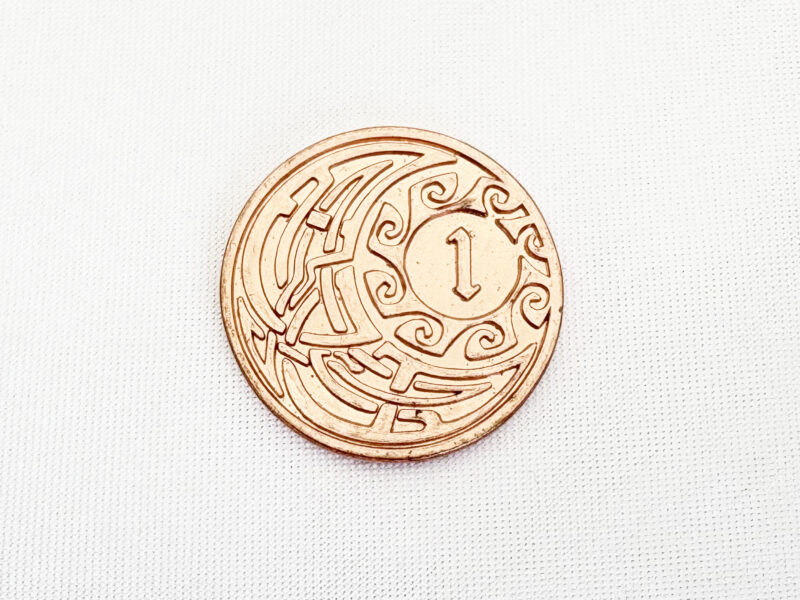
When a board game designer asks for metal coins, the first question we ask back is: what should they feel like? Heavy and premium? Crisp and detailed? Magnetic? The answer points to the metal. Most custom game coins and tokens are made in zinc alloy, but brass and iron both have a place, and choosing the wrong one can cost you detail, weight, or budget.
This guide compares zinc alloy vs brass vs iron for board game coins and tokens from the perspective of WangFuk, an OEM / ODM metal factory in Chang-an, Dongguan that has produced coins, tokens, dice, and miniatures since 2000. We are quote-only, so we talk about cost factors, not prices.
The short answer
- Zinc alloy — the default for most game coins and tokens. Die casting captures fine relief, sculpted 3D shapes, and enamel wells, and it takes almost every plating colour.
- Brass — for a denser, solid-metal feel and a natural gold tone. Usually a premium choice with a different process and tooling.
- Iron — for flatter, stamped tokens, or when you want the coins to be magnetic. It must be plated or coated to prevent rust.
Side-by-side comparison
| Factor | Zinc alloy | Brass | Iron (low-carbon steel) |
|---|---|---|---|
| Typical process | Die casting | Stamping / striking; casting or machining in some cases | Stamping |
| Detail and 3D shapes | Excellent — sculpted relief, cut-outs, enamel wells | Crisp on flat relief; deep 3D is harder | Good on flat relief; limited 3D |
| Density (textbook value) | about 6.6–6.7 g/cm³ | about 8.4–8.7 g/cm³ | about 7.9 g/cm³ |
| Magnetic | No | No | Yes |
| Surface protection | Plated or coated | Can be left natural and lacquered, or plated | Must be plated or coated |
| Main cost drivers | Mould complexity, finish | Raw material, striking dies, finishing | Blanking and striking dies, rust-proof finish |
Density figures are general material reference values, not WangFuk product specifications. Actual piece weight always depends on your diameter, thickness, and relief, and we confirm it on the sample.
Zinc alloy: the workhorse for game coins
For the majority of coin and token programs we use zinc alloy die-casting stock. Molten alloy fills a steel mould, so the coin can carry fine lettering, textured backgrounds, raised numerals, and recessed wells for soft or hard enamel. It is also the natural choice for sculpted pieces, such as our GOLD BRIDGE game tokens, and for metal miniatures and metal dice, which lets one plating language run across a whole game.
Why designers choose it
- High detail at gift and tabletop thicknesses
- Shaped outlines, cut-outs, and 3D surfaces are practical
- Works with bright, antique, gunmetal, and dual plating, plus enamel, paint, and clear coat
- Weight can be tuned by thickness and diameter
Watch-outs
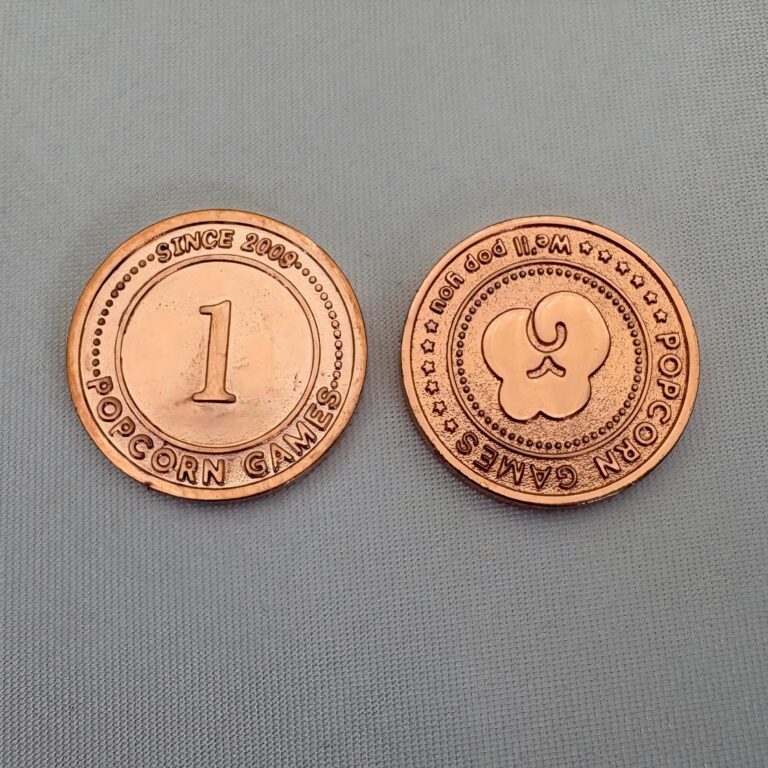
Zinc alloy is almost always plated, so the plating and polish define the look. Very thin sections and large flat, unrelieved areas are harder to finish evenly, so we review these at the artwork stage. If you want a copper or bronze look, plating does the job: the coins below are zinc alloy with copper-tone plating, not solid copper.
Brass: heavier and more “real coin”
Brass is a copper-zinc alloy, and with a textbook density of about 8.4–8.7 g/cm³ it feels noticeably heavier in the hand than a zinc coin of the same size. Its natural gold colour can be polished and lacquered, or it can be plated like any other coin.
When brass makes sense
- Premium or collector editions where weight and a solid-metal feel are the selling point
- Flat, coin-style designs with relief that can be struck, rather than deep sculpted shapes
- Projects that want a natural metal tone that ages over time
Watch-outs
Brass usually means a different production route from zinc die casting, so tooling and process change, and raw material is a bigger share of the cost. Unplated brass tarnishes with handling unless lacquered. Some brass grades contain lead to improve machinability, so if your markets require lead limits, state the standard in your RFQ and we will select material and testing accordingly. If brass is on your list, say so at the start — switching later means new tooling.
Iron: magnetic and practical for flat tokens
Iron (in practice, low-carbon steel) is typically stamped from sheet into flat tokens, counters, and markers. Its standout property for game design is magnetism: iron tokens can snap to a magnetic board or be held in a magnetic storage tray, which zinc and brass cannot do.
When iron makes sense
- Flat counters, markers, or tokens with simple relief
- Game mechanics or storage that rely on magnets
- Designs where density between zinc and brass gives the right feel
Watch-outs
Iron rusts, so it must be plated or coated, and edges need good coverage. It is less suited to deep sculpted relief than die-cast zinc. For reference, several of our published EN71-3 soluble-lead sample reports were run on iron counterweight parts — see our Lab Tests page.
What about bimetal coins?
Two-metal constructions, with a ring and a center in different metals, are a separate program with their own tooling and assembly. We make bimetal challenge coins, and the same idea can be quoted for premium game currency. For most games, dual plating on a single zinc coin gives a two-tone look with less complexity. Our plating options guide covers the colours.
How to choose: five questions
- What weight feel do you want? If “heavy” is the brief, compare a thicker zinc coin with brass on the sample before deciding.
- Is the design flat or sculpted? Sculpted 3D shapes point to zinc die casting.
- Do the coins need to be magnetic? Only iron / steel will work.
- Natural metal or plated? Natural gold tone suggests brass; everything else can be plated on zinc.
- What are your target markets? List lead and nickel requirements (for example EN71-3, ASTM F963, REACH nickel release) so material and plating are chosen with testing in mind.
For quantity, MOQ, and timeline planning, read our companion guide to Kickstarter metal game coins: MOQ, cost and timeline. For the zinc route in detail, see the metal coin manufacturing process and zinc alloy die casting guides.
Testing and quality
Whatever metal you choose, plating and material affect compliance. We publish real STC sample lab reports for EN71-3 soluble lead, ASTM F963-23 total lead, and REACH nickel release on our Lab Tests page. These are product / material sample tests, not factory audit certificates, and extra tests for your markets can be arranged with your RFQ. Dimensions, plating, and packing checks are covered on our Quality Control page, and you can see the workshops on the factory page.
Get a material recommendation and quote
Not sure which metal fits? Send your artwork and tell us the feel you want. We will recommend a material and process, and quote tooling, samples, and unit pricing. MOQ is flexible and often starts from about 50–100 pcs per design, confirmed per design.
Send your drawing — request a quote
WhatsApp +86 186 8236 9779 · Hong Kong +852 3752 2079 · Dongguan factory +86 769 8162 8979.
FAQ
Which metal is best for board game coins?
For most games, zinc alloy. It die casts fine detail and 3D shapes and takes nearly every plating and enamel finish. Brass suits premium coins where weight and natural gold tone matter; iron suits flat or magnetic tokens.
Are brass game coins heavier than zinc alloy?
Yes, for the same size. Brass has a textbook density of about 8.4–8.7 g/cm³ versus about 6.6–6.7 g/cm³ for zinc alloy. Zinc coins can also be made thicker to increase weight.
Can metal game tokens be magnetic?
Only if they are made from iron or steel. Zinc alloy and brass are not magnetic. Iron tokens must be plated or coated to prevent rust.
Does the material change the cost of game coins?
Yes. Material affects raw material cost, the production process, and the tooling required. We quote each program from your drawings; there is no public price list.