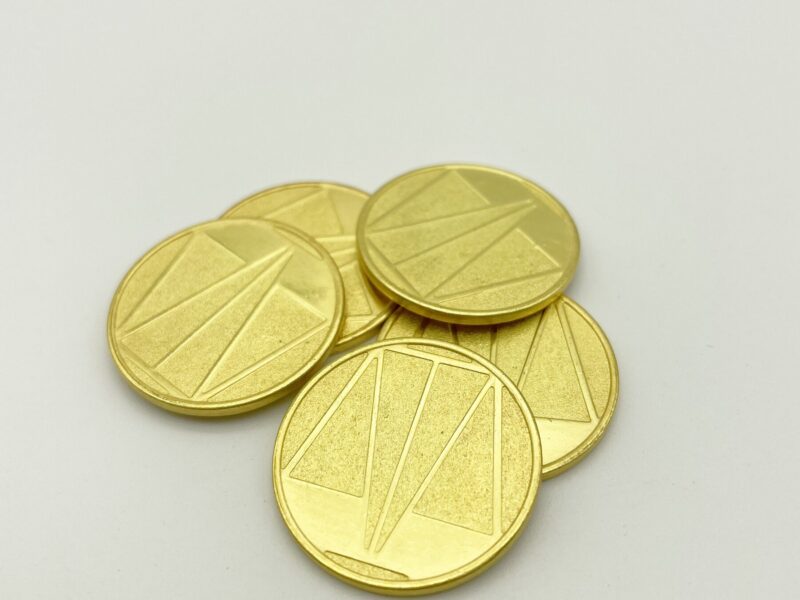
Every custom metal game coin starts as a drawing. The steel mould is cut from your artwork, so the files you send decide how crisp the numerals look, how cleanly the enamel colours sit, and how many sampling rounds you need. Good files save time; unclear files lead to questions, assumptions, and re-tooling.
This guide explains how to prepare artwork files for custom metal game coins and tokens, from file formats to relief levels, enamel colours, and denomination sets. It is written by WangFuk, an OEM / ODM metal factory in Chang-an, Dongguan that makes board game coins, tokens, dice, and miniatures. We are quote-only, so this is about getting your design ready for an accurate quote and sample, not about prices.
1. Send vector files, drawn at real size
Vector artwork is the most reliable starting point for a coin mould. It scales without blurring and lets our engineers read every outline exactly.
- Preferred formats: AI, PDF, EPS, SVG, or CDR with fonts converted to outlines.
- Real size in millimetres: draw each face at 1:1 and state the diameter (or outline size) and the thickness you want.
- One artboard per face: front and back of every coin, clearly named (for example “Gold 10 – front”).
- Raster only? A high-resolution PNG or JPG is fine as a reference. Add the finished size in mm and we will redraw it for tooling, then ask you to confirm.
- Sculpted shapes: for 3D tokens or coins with portrait-style relief, a 3D file or a physical reference sample is welcome alongside the 2D drawing.
2. Think in metal levels, not just colours
A printed card shows colour. A metal coin shows height. Before you send files, decide which areas are:
- Raised metal — borders, numerals, and outlines that catch the light after polishing and plating.
- Recessed — the lower background, often textured or filled with enamel.
- Sculpted (3D) — gradual relief such as faces, creatures, or landscapes, which suits zinc alloy die casting.
The simplest way to show this is a second version of each face where raised areas are one flat colour and recessed areas another. A short note such as “numerals raised and polished, background recessed with sand texture” removes most guesswork. If you are unsure, send the design as it is and we will propose the levels on the drawing for your approval.
3. Keep fine details readable in metal
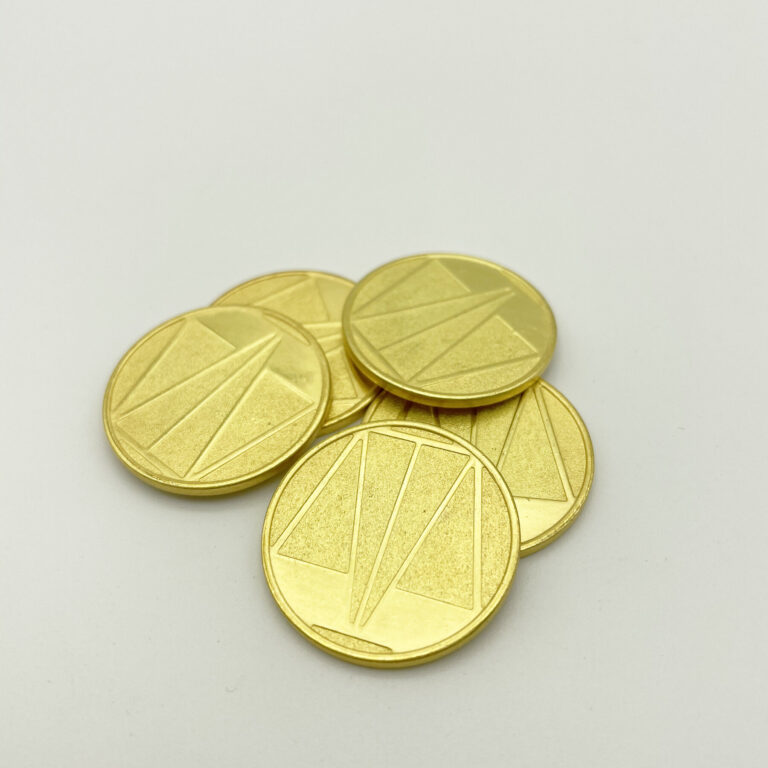
Polishing and plating slightly soften very thin lines, tiny text, and sharp inner corners. On a game coin, the parts players must read across the table matter most.
- Make denomination numerals bold and simple; decorative fonts can blur at coin sizes.
- Avoid hairline strokes and very small text in the recessed background.
- Flag any element that must stay crisp, such as a logo or a value, so we can review it on the drawing.
- Leave some clear space between the outer rim and the artwork so the edge finishes cleanly.
Detail limits depend on size, relief, and finish, so we confirm them per design rather than quoting one rule for every coin.
4. Specify enamel colours with Pantone references
Soft and hard enamel colours sit in recessed cells separated by raised metal lines. That has two consequences for your artwork:
- Every colour area needs a metal boundary. Two enamel colours cannot touch without a thin raised wall between them.
- Use flat spot colours. Gradients, shadows, and photographic images do not translate into enamel fills. Simplify them to flat areas, or ask us about alternatives with your RFQ.
List a Pantone (PMS) reference for each colour where possible. Screen colours vary, so final colours are approved on the physical sample. For finish choices, see our guide to metal game token finishes, plating and enamel and soft vs hard enamel.
5. Plan the denomination set as one system
Most game currencies come in several values. Designing them together keeps the set consistent and easier to produce.
- Make values easy to tell apart. Combine at least two cues — numeral, plating colour, size, or enamel colour — so players with colour-vision differences can still sort coins quickly.
- Decide what is shared. A common reverse side or border across all values can simplify tooling. We confirm what can be shared when we quote.
- State the count per game copy for each value, so quantities and packing are planned correctly.
Material affects how each value feels in the hand; our zinc alloy vs brass vs iron comparison covers weight and magnetism.
6. Don’t forget the edge and thickness
The edge is part of the artwork. Tell us whether you want a plain edge or a patterned one, and whether the edge is plated the same colour as the faces. Thickness changes weight, stack height, and how the coin sits in your box insert, so check it against your insert or bag before tooling.
7. Confirm you have rights to the artwork
If a coin carries a brand, a licensed character, or a third-party logo, make sure you have permission to reproduce it. We may ask for an authorisation letter before tooling. Original game art from your own studio is the simplest case.
What happens after you send artwork
- We review the files and confirm the process: die casting or stamping, plating, and enamel.
- We quote tooling, sample, and unit pricing, and point out any details that may not read well in metal.
- After you confirm, we make a pre-production sample, typically in about 7–10 days.
- You approve the sample (colours, weight, finish), then mass production runs, typically about 15–20 days depending on quantity and finish.
Timeline and quantity planning for crowdfunded games is covered in our Kickstarter metal game coins guide.
Artwork checklist
- Vector file per face (AI / PDF / EPS / SVG / CDR), fonts outlined
- Finished diameter or outline size and thickness, in mm
- Raised / recessed / sculpted areas marked
- Pantone references for each enamel colour
- Plating colour per denomination
- Edge style and edge plating
- Number of values and coins per game copy
- Rights or authorisation for any third-party artwork
Send your artwork for a quote
Send what you have — even a sketch with sizes — and we will tell you what is needed to tool it. MOQ is flexible and confirmed per design.
Send your artwork — request a quote
WhatsApp +86 186 8236 9779 or +86 180 0266 9380 · Hong Kong +852 3752 2079 · Dongguan factory +86 769 8162 8979.
FAQ
What file format is best for custom metal coin artwork?
Vector files such as AI, PDF, EPS, SVG, or CDR, drawn at real size in millimetres with fonts converted to outlines. A high-resolution image is acceptable as a reference; we redraw it for tooling and ask you to confirm.
Can enamel coins have gradients or photo images?
Not in the enamel itself. Enamel colours are flat and each colour sits in a cell separated by raised metal lines. Simplify gradients to flat spot colours, or ask about alternatives with your quote.
Do I need a 3D file for sculpted game tokens?
It helps but is not required. A 3D file or a physical reference sample makes sculpted relief faster to interpret; a clear 2D drawing with notes is enough to start a quote.