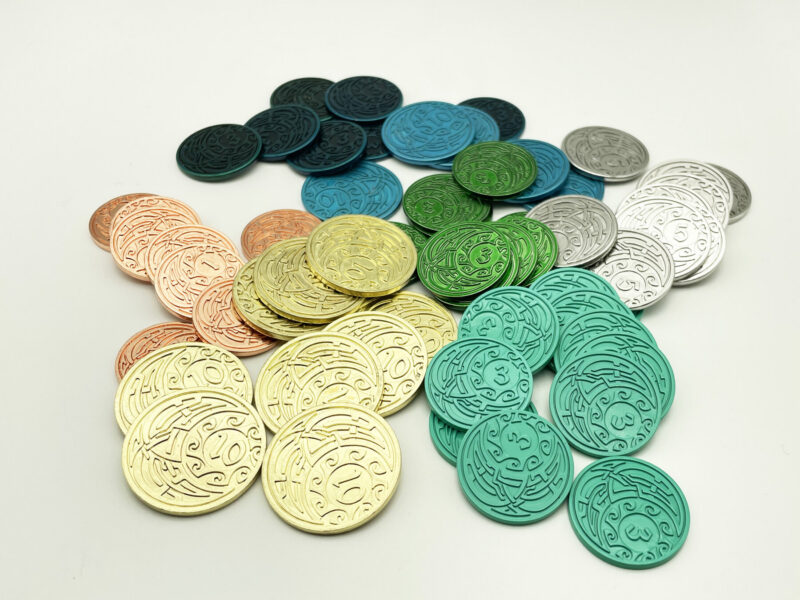
A single metal coin looks great in a photo. A full set of coins has to work at the table: players need to tell a 1 from a 5 in a dim room, count change quickly, and pull the right value out of a crowded tray without reading tiny numbers. That is what denomination design is about. This guide walks through how we help publishers plan a multi-value metal coin set, from choosing how many values to include to getting samples approved.
Why denomination design matters
Coins in a game are a user interface. If two values look too similar, players slow down, make mistakes and eventually ignore the upgrade and go back to cardboard. A good set feels obvious: each value has its own size, color and feel, and the whole set still looks like it belongs to the same world.
Getting this right early also saves money. Every distinct coin design usually needs its own mold, so the number of values and the way they differ have a direct effect on tooling and on your timeline.
Step 1: Decide how many values you really need
Start from the game economy, not from the coins. Look at your rules and count how often players make change. Many games work well with three values (for example 1, 5 and 10). Heavier economic games sometimes need four or five.
Questions we usually ask:
- What is the most common payment in a turn? That value should be the easiest to handle.
- Do players ever need more than about fifteen coins of one value at once? If so, a higher value may help.
- Is there a “special” currency (gems, crowns, victory points) that should look clearly different from ordinary money?
Fewer values means fewer molds and a simpler box insert. More values can make the game faster, but only if each value is easy to recognize.
Step 2: Make each value recognizable at a glance
Players identify coins by several cues at once. Use at least two of them for every value.
Diameter. The simplest cue. A step of roughly 3–5 mm between values is easy to feel and see. Typical game coins sit somewhere between about 20 mm and 35 mm in diameter.
Color. Plating gives you gold, silver, copper, antique bronze, black nickel and more. Soft enamel or spray color can add a colored field. Avoid using two similar metallic tones (for example light gold and brass) for neighboring values.
Thickness and weight. A thicker, heavier high-value coin feels “important” in the hand. Thickness also affects stacking height in your insert, so plan both together.
Edge and shape. A reeded edge, a beaded rim, a scalloped outline or a hole in the center (round or square) adds a tactile cue that works even when players are not looking. Non-round shapes such as oblong or polygonal coins are possible with custom molds.
Number and symbol. Keep the value large and bold. A symbol that repeats across the set (a crest, a resource icon) ties the coins together, while the number does the real work.
Step 3: Plan quantities per value
Quantity planning affects both gameplay and production. A common pattern is many low-value coins and fewer high-value ones, mirroring how the game is actually played. Playtest with cardboard or plastic stand-ins and count how many of each value end up in circulation at the busiest moment of a game, then add a margin.
Write the quantity per value per game copy into your brief. It makes quoting more accurate and helps us suggest the right packing method (bags per value, trays, or a mixed bag).
Step 4: Artwork that scales across a set
Design the set as a family:
- Use one frame or border style and change only the center motif and the number.
- Keep line widths readable at the smallest diameter. Fine details that look sharp on a 35 mm coin can fill in on a 22 mm coin.
- Plan front and back. Many publishers put the value on both sides so coins never need flipping.
- Supply vector files (AI, EPS or PDF) with heights or relief levels marked, plus Pantone references for any enamel colors.
Our separate guide on artwork files goes into file preparation in more detail.
Step 5: Material and finish choices for a set
Most denomination sets use zinc alloy because it die-casts fine detail and allows thick, heavy coins at a reasonable weight. Brass and iron are options when a specific feel or price point is needed — see our comparison of zinc alloy, brass or iron for board game coins.
For finishes, a classic approach is copper for the lowest value, silver for the middle and gold for the highest, sometimes with an antique wash to bring out relief. Colored enamel fields can mark special currencies. Our article on plating and enamel options explains what each finish looks like in real use.
You can see examples of multi-color denomination coins and numbered metal coins on our product pages, or browse all custom metal game tokens.
Tooling, samples and lead time for multi-value sets
Each unique design (each value, and each different front/back) normally needs its own mold. As a general guide:
- Tooling: about 7–10 days after artwork approval.
- Sampling: about 7–10 days, so you can check size steps, colors and weight side by side.
- Mass production: about 15–20 days after sample approval, depending on quantity and finish.
First orders of 50–100 pcs per design are acceptable, which makes it practical to test a set with backers or at a convention before committing to a large run. We recommend approving all values of a set together from one sample batch so colors and sizes are consistent.
Checklist before you request a quote
- Number of values and the quantity of each per game copy
- Target diameter and thickness for each value
- Finish per value (plating color, antique or bright, enamel colors)
- Edge or shape details (reeded, beaded, hole, non-round)
- Front and back artwork in vector format
- Packing method (per value bags, trays, insert dimensions)
- Total number of game copies for the first run
Send these details through our quote request form and we will come back with tooling and unit quotations, sample timing and any design suggestions to make your coin set easier to use at the table.